Showing posts with label Gastro. Show all posts

Monday, May 14, 2018

The Gastrocardiac Syndrome

Roemheld syndrome (RS) or gastric-cardiac syndrome, is a complex of gastrocardiac symptoms where issues with gut are found to be associated with cardiac symptoms like arrhythmias and benign palpitations. Despite a full workup, when the cause of symptoms is not found then this condition is one of the possible diagnosis. These are the patients who are often labeled as  "Non-Cardiac Chest Pain' or "MSK related CP" in the Emergency Department. 

Possible reasons for Gastrocardiac Syndrome
  • Anatomical close proximity between the stomach and the heart (GERD, Hiatus Hernia)
  • Same nerve supply - Vagus Nerve (Compressed by distended stomach leaading to bradycardia and occasionally arrythmias)
  • PPIs (Often used for GERD/Peptic ulcer) leading to HypoMg leading to ectopic beats

Due to pressure in the epigastric and left hypochondrium, the diaphragm is elevated and displaces the heart. This reduces the heart's ability to fill and increases the contractility of the heart causing palpitations/dizziness/anxiety. Typically, there are no changes/abnormalities related in the EKG detected. 


Symptoms can be variable and include a whole list of GI and Cardiovascular symptoms:  They are usually seen after eating a meal.
  • Sinus Bradycardia
  • Shortness of Breath
  • Chest tightness, Anxiety
  • Muscle crampiness
  • Dizziness
  • Palpitations
  • Belching, nausea

Conditions that come under the spectrum of RS:
  • GERD
  • Hiatus Hernia
  • Lactose intolerance
  • Gall Bladder disease
  • Intestinal Disorders 
RS in an ED diagnosis and our workup must include ECGs and troponins. Extensive GI and Cardiac workup are needed before calling this condition. Therefore, the diagnosis is made based on symptoms in the absence of heart abnormalities. 

Management
Ruling out another diagnosis such as peptic ulcer, bowel cancer, GB disease, ACS is the priority. Treatment is based on symptoms relief. Medications that have found to help include Anticholinergics, Antacids, Beta-Blockers, Anti-convulsants and simethicone. 

Take Home:
Gastrocardiac Syndrome is not an ED diagnosis. Always think of ACS first but beware of close proximity between stomach and heart.

References:

  1. Gastrocardiac syndrome: A forgotten entity; Saeed, Mohammad et al. The American Journal of Emergency Medicine , Volume 0 , Issue 0
  2. Jervell, O. and Lødøen, O. (1952), THE GASTROCARDIAC SYNDROME. Acta Medica Scandinavica, 142: 595-599. doi:10.1111/j.0954-6820.1952.tb13409.x
  3. The effect of the lateral decubitus position on vagal tone. Chen GY, Kuo CD. Anesthesia 1997 Jul;52(7):653-7. Department of Medicine, Provincial Tao-Yuan General Hospital, Republic of China.


Posted by:

              
     Lakshay Chanana
     
     Speciality Doctor
     Northwick Park Hospital
     Department of Emergency Medicine
     England

     @EMDidactic

Monday, February 5, 2018

Paediatric Gastroenteritis Review


Acute Gastroenteritis (AGE) kills thousands of children each year and consequences are worse in the developing world as diarrhoeal diseases occur on top of pre-existing malnutrition. It remains one of the most common ED presentation among children. Fortunately, most cases of acute gastroenteritis require minimal intervention, but severe dehydration and hypoglycemia may develop in cases of prolonged vomiting and diarrhoea requiring prompt management. The mainstay of treatment for mild-to-moderately dehydrated patients with acute gastroenteritis is oral rehydration solution (ORS). Antiemetics such as Ondansetron can decrease the need for intravenous fluids and hospitalisations.


Viral pathogens are the most common cause of AGE, accounting for up to 80% of cases


Common Bugs
E coli and Shigella are the most common bacterial pathogens in developing countries whereas Campylobacter is the most common bug in the developed world. Since most cases are viral, antibiotics are not required and only a few bacterial infections require treatment with antibiotics to hasten recovery and decrease bacterial shedding. It is critical to remember that some bacterial causes of colitis (ie, E coli O157:H7) can cause HUS that may be exacerbated by antibiotic administration. Therefore, antibiotics should not be started in most cases of suspected bacterial AGE until the species has been identified. Exceptions are made for children who are critically ill. Antibiotics do not come without side effects. Also, each course of antibiotics alters gut biome and can lead to a myriad of GI distress manifesting as abdominal pain, nausea, vomiting, and diarrhoea and  C diff colitis. Thus it is imperative to check recent antibiotic use in all patients who present with vomiting and diarrhoea. 


Children aged < 12 months should always be approached with a very broad differential. The most serious diagnosis to consider is intestinal malrotation and volvulus 


Brief Pathophysiology
Infection leads to gut biome alteration and host’s own immune system leads to inflammation of the lining of the stomach and intestines causing abdominal pain, nausea, vomiting, diarrhea, and hematochezia.


Vomiting that has continued for more than 24 to 48 hours without diarrhea is not AGE, and, while it may represent merely gastritis, a broad differential should be considered.


Key Questions in history:

  • Color of both the emesis and stool (bilious or bloody emesis and bloody stools) 
  • Fever
  • History of recent travel and sick contacts 
  • Quantity of urine output
  • Regular medications or recent Antibiotic intake 


Protein allergies should be in the differential diagnosis in young infants presenting with vomiting and diarrhoea. 


Physical Exam and determining the degree of dehydration

  • Vital Signs including CRT
  • Hypotension is a late finding in children
  • Segregate as  mild dehydration (< 3% loss of body weight - Normal exam), moderate dehydration (3%-9% loss of body weight - may have slightly sunken eyes, decreased tears, dry mouth, and slightly increased heart rate) or severe dehydration (> 9% loss of body weight - lethargic and tachycardic, with no tears, very dry mouth, and prolonged capillary refill)
  • Abdo exam - localised tenderness to palpation. AGE might cause mild diffuse abdominal pain but not focal tenderness. 


Bloods, Imaging and Cultures

  • Bloods are not required in mild to moderate illness. Inflammatory markers such as CRP has not been shown to differentiate viral versus bacterial causes of AGE and is not recommended in obvious cases of AGE. 
  • Stool cultures and other stool studies are not required in most cases of uncomplicated AGE. However, ichildren with prolonged (> 3 days) or bloody diarrhea, toxic-appearance, and those with h/o recently travel abroad, stool cultures may be appropriate. 
  • Stool ova and parasite examinations (Giardiasis, Toxocariasis and Cysticercosis)  are low-yield tests and should only be sent with appropriate travel history or prolonged disease with negative prior stool cultures or if there is evidence of weight loss or failure to thrive.
  • Fecal calprotectin is an inflammatory marker in the stool which may aid in differentiating viral from bacterial AGE. Children with bacterial infections had signicantly higher levels of fecal calprotectin in the stool than children with viral infections. In general, fecal calprotectin does not affect the acute management of vomiting and diarrhea in the ED but it may be helpful in the outpatient workup of other illnesses, and can be sent in consultation with pediatric gastroenterology. 


Laboratory studies should be obtained in
all neonates with any level of dehydration and in

patients with an altered mental status not explained

by their suspected level of dehydration.


Treatment 


1. ABC (IV Cannula and fluid resus in critically ill, hypotensive, Consider Abx)

2. Antiemetics
PO/IV Ondansetron is safe and effective for AGE treatment in the ED. Vomiting children who are given ondansetron prior to an oral challenge are less likely to fail oral rehydration, require IV hydration, and be admitted to the hospital. Children treated with ondansetron also leave the ED sooner than those who are not given ondansetron prior to oral challenge. Most studies recommend the following oral pediatric dosing guidelines for ondansetron: children weighing < 15 kg: 2 mg; children weighing 15 kg to 30 kg: 4 mg; children weighing ≥ 30 kg: 8 mg. If the oral disintegrating tablets or oral solution are not available or tolerated, the IV preparation can be given orally. For children with severe dehydration in whom IV hydration will be started immediately, IV ondansetron can be given (0.15 mg/kg, max 8 mg).

3. Rehydration 

Liquids such as water, juices, sports drinks, soups, etc, are not traditionally recommended for mild-to- moderate dehydration because they do not contain the ideal ratio of sugars and salts to promote intestinal absorption, and they may serve as an osmotic diuretic. However, in a recent study from Canada, children with minimal dehydration due to AGE were treated with dilute apple juice had less treatment failure and less IV fluid administration. 


Oral challenge should be given as 5- 10 mL every 5 minutes for the first 30 minutes. If the child is tolerating, then the amount consumed can be increased by 5-mL increments over the next 30 minutes. Depending on the degree of dehydration, 50 to 100 mL/kg of ORS should be given over 3 to 4 hours to correct dehydration. Those who fail oral rehydration after antiemetics get IV (do Renal Function, Electrolutes, Glucose when inserting IV) or NG fluids. 


Majority agrees on starting with a 20 mL/kg NS bolus crystalloids. In children with stable blood pressure and normal capillary refill, infusion over 30 to 60 minutes is appropriate. In severely dehydrated patients appearing toxic, administer bolus IV fluids. Additionally, in if they are hypoglycaemic, then start with a 20 mL/kg bolus of D5NS followed by crystalloids. 


4. Anti-Diarrheal agents 
Loperamide is an opioid receptor agonist that acts as both an antisecretory and antimotility agents but has the potential of causing drowsiness and ileum. Thus it is strongly discouraged in children of all ages. Bismuth Salicylate is another option but it may cause salicylate toxicity if it is used incorrectly and therefore, it is also not recommended for use in children. 


Racecadotril is another antidiarrheal drug that has been shown in a few studies to reduce the duration and frequency of diarrhea in infants and children. It is an enkephalinase inhibitor and results in decreased secretion of water and electrolytes into the intestines. A recent meta-analysis of studies that examined the effectiveness of racecadotril in decreasing diarrhea found that it was well-tolerated and resulted in decreased duration of symptoms, as well as less stool frequency and volume. However, the included studies were of poor quality and subject to bias. 


5. Probiotics
  • Probiotics are nonpathogenic organisms that work by regulating the gut biome and help to lessen in ammatory pathways. These agents help to decrease stool volume and frequency in AGE. Numerous studies have shown that Lactobacillus rhamnosus GG and Saccharomyces boulardii can reduce the length of diarrheal symptoms in children, with very few side effects but probiotics are probably most effective if started early. Also probiotics seem to have the greatest impact on diarrhea due to viral causes.
  • Prebiotics are food products that promote the growth and activity of bacteria that reside in the gut and Synbiotics are a combination of probiotics and probiotics. 


6. Zinc
Zinc supplementation should be strongly considered when treating diarrhea in children residing in developing countries; supplementation significantly reduces diarrhea duration in children with underlying zinc deficiency. 


Safety Netting and discharge advise: Advise parents and carers of children:

  • To continue usual feeds, including breast or other milk feeds and include ORS solution as supplemental fluid
  • To discourage the drinking of fruit juices and carbonated drinks
  • A rough calculation of the amount of ORS needed to replace emesis and diarrhea is 10 mL/kg for each episode of emesis or diarrhoea
  • To seek advice if the child refuses to drink the ORS solution or vomits persistently
  • Usual duration of diarrhoea is 5–7 days and in most children it stops within 2 weeks
  • Usual duration of vomiting is 1 or 2 days and in most children it stops within 3 days
  • Advise regarding hand Hygiene and inform that children should not go back to their school or other childcare facility until at least 48 hours after the last episode of diarrhoea or vomiting. 


Take Home:

  • Start ondansetron early to children presenting with AGE. 
  • Mainstay of treatment is oral rehydration with ORS and IV fluids are indicated only in severe dehydration or in children who are unable to take ORS orally.
  • Laboratory studies are not indicated in mild-to-moderate dehydration due to AGE. In children with severe dehydration, start IV fluids and do renal function, blood glucose and electrolytes. 
  • Probiotics can help decrease the duration of their diarrhea by approximately 24 hours but should be prescribed for children with AGE early in the course of their illness.Viral infections are the most common cause of AGE, so stool cultures are not needed. 

References and Further Reading:

  1. http://pedemmorsels.com/diarrhea-and-dehydration/
  2. http://pedemmorsels.com/probiotics-for-age/
  3. Roslund G, Hepps TS, McQuillen KK. The role of oral ondansetron in children with vomiting as a result of acute gastritis/gastroenteritis who have failed oral rehydration therapy: a randomized controlled trial. Ann Emerg Med. 2008;52(1):22-29. 
  4. O’Ryan M, Lucero Y, O’Ryan-Soriano MA, et al. An update on management of severe acute infectious gastroenteritis in children. Expert Rev Anti Infect Ther. 2010;8(6):671-682. 
  5. Bonadio WA. Acute infectious enteritis in children. Emer- gency department diagnosis and management. Emerg Med Clin North Am. 1995;13(2):457-472.
  6. Bruzzese E, Lo Vecchio A, Guarino A. Hospital management of children with acute gastroenteritis. Curr Opin Gastroen- terol. 2013;29(1):23-30. 
  7. Sýkora J, Siala K, Huml M, et al. Evaluation of faecal calpro- tectin as a valuable non-invasive marker in distinguishing gut pathogens in young children with acute gastroenteritis. Acta Paediatr. 2010;99(9):1389-1395. 
  8. Duman M, Gencpinar P, Biçmen M, et al. Fecal calprotectin: can be used to distinguish between bacterial and viral gas- troenteritis in children? Am J Emerg Med. 2015;33(10):1436- 1439. 
  9. Leung AK, Robson WL. Acute gastroenteritis in children: role of anti-emetic medication for gastroenteritis-related vomiting. Paediatr Drugs. 2007;9(3):175-184. 
  10. Freedman SB. Acute infectious pediatric gastroenteritis: beyond oral rehydration therapy. Expert Opin Pharmacother. 2007;8(11):1651-1665. 
  11. Levine DA. Antiemetics for acute gastroenteritis in children. Curr Opin Pediatr. 2009;21(3):294-298.
  12. Marchetti F, Bonati M, Maestro A, et al. Oral ondansetron versus domperidone for acute gastroenteritis in pediatric emergency departments: multicenter double blind ran- domized controlled trial. PLoS One. 2016;11(11):e0165441. 
  13. Freedman SB, Tung C, Cho D, et al. Time-series analysis of ondansetron use in pediatric gastroenteritis. J Pediatr Gastroenterol Nutr. 2012;54(3):381-386. 
  14. Magrone T, Jirillo E. The interplay between the gut immune system and microbiota in health and disease: nutraceutical intervention for restoring intestinal homeostasis. Curr Pharm Des. 2013;19(7):1329-1342. 
  15. Vandenplas Y, De Greef E, Hauser B, et al. Probiotics and prebiotics in pediatric diarrheal disorders. Expert Opin Phar- macother. 2013;14(4):397-409. 
  16. Caffarelli C, Cardinale F, Povesi-Dascola C, et al. Use of pro- biotics in pediatric infectious diseases. Expert Rev Anti Infect Ther. 2015;13(12):1517-1535. 
  17. Thomas DW, Greer FR, Committee on Nutrition; Section on Gastroenterology, Hepatology, and Nutrition. Probiotics and prebiotics in pediatrics. Pediatrics. 2010;126(6):1217-1231. 
  18. Colletti JE, Brown KM, Sharieff GQ, et al. The management of children with gastroenteritis and dehydration in the emer- gency department. J Emerg Med. 2010;38(5):686-698. 
  19. Freedman SB, Willan AR, Boutis K, et al. Effect of dilute apple juice and preferred uids vs electrolyte mainte- nance solution on treatment failure among children with mild gastroenteritis: a randomized clinical trial. JAMA. 2016;315(18):1966-1974. 
  20. Granado-Villar D, Cunill-De Sautu B, Granados A. Acute gastroenteritis. Pediatr Rev. 2012;33(11):487-494.
  21. Gordon M, Akobeng A. Racecadotril for acute diarrhoea in children: systematic review and meta-analyses. Arch Dis Child. 2016;101(3):234-240. 
  22. https://www.nice.org.uk/guidance/cg84/chapter/1-Guidance#antibiotic-therapy

Posted by:

              
     Lakshay Chanana
     
     Speciality Doctor
     Northwick Park Hospital
     Department of Emergency Medicine
     England

     @EMDidactic


Monday, August 7, 2017

Ulcerative Colitis - ED Management

Ulcerative colitis (UC) is a chronic inflammatory relapsing and remitting disease of the colon. The etiology is believed to be autoimmune with some genetic component. Peak incidence occurs in the second and third decades of life with characteristic symptom of bloody diarrhoea. The rectum is almost always involved in UC. 

Factors associated with an unfavourable prognosis include higher severity and extent of disease, a short interval between attacks, systemic symptoms, and onset of the disease after 60 years of age.


Clinical Presentation

Crampy abdominal pain, bloody diarrhea, and tenesmus are typical symptoms of UC. The disease is classified as mild, moderate, or severe depending on the clinical manifestations. 

Truelove and Witts criteria


Extra intestinal Manifestations 


Diagnosis

ED diagnosis of ulcerative colitis rests on the following: 
History of abdominal cramps and diarrhea, mucoid stools, stool examination negative for ova and parasites, stool cultures negative for enteric pathogens, and confirmation of diagnosis by colonoscopy.


Treatment


Mild to Moderate attacks
Most of these patients can be treated as outpatients. A combination of oral (2.4 grams/day) and topical mesalamine is used. Topical glucocorticoid enemas or Mesalazine enemas or suppositories (500 milligrams twice a day) are quite effective in distal proctosigmoiditis and have lower systemic side-effect profiles.

If topical therapy is unsuccessful, steroids (40-60md Prednisolone/day) are effective in inducing a remission in the majority of cases. Antidiarrheal agents are generally ineffective and may precipitate toxic megacolon.


Rx of UC based on severity of disease

Severe ulcerative colitis - Treat with IV steroids, fluids, correct electrolyte abnormalities, broad-spectrum antibiotics, melamine. IV cyclosporine (2-4 milligrams/kg per day) or infliximab (5 milligrams/kg) can be effective in fulminant colitis nonresponsive to IV steroids.


Complications
  • LGI Bleed (Most Common)
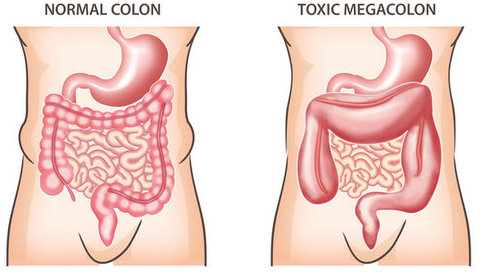
  • Toxic Megacolon The most feared complication of ulcerative colitis is the development of toxic megacolon. TM occurs as a result of extension of the inflammation beyond the submucosa, causing loss of contractility and dilated colon. Dilation of the colon is associated with a worsening of the clinical condition and development of fever and prostration. Patients with Toxic Megacolon appear toxic with distended, tender and tympanic abdomen. They typically present with fever, tachycardia and shock.

Plain radiography of the abdomen demonstrates a long, continuous segment of air-filled colon greater than 6 cm in diameter. Loss of colonic haustra represent bowel wall edema. Occasionally, features of toxic megacolon, such as leukocytosis, anaemia, dyselectrolytemia, hypoalbuminemia and peritonitis, can be masked in the patient taking corticosteroids.  


Antidiarrheal agents, hypokalemia, narcotics, cathartics, pregnancy, enemas, and recent colonoscopy have been implicated as precipitating factors in toxic megacolon. Rx with nasogastric suction, IV steroids, broad-spectrum antibiotics active against coliforms and anaerobes, and IV fluids. Get a surgical consultation ASAP.
  • Perforation
  • Bowel Obstruction (due to strictures)
  • Carcinoma Colon  (Advanced and prolonged disease)
  • Perirectal fistulas and abscesses 

Disposition
Fulminant attacks of ulcerative colitis need hospitalization for fluid and electrolyte management and careful observation for the development of complications. Patients with complications such as GI Bleed, toxic megacolon, and bowel perforation should also be admitted. In addition to toxic megacolon, the indications for surgery include colonic perforation, massive lower gastrointestinal bleeding, suspicion of colon cancer, and disease that is refractory to medical therapy (large doses of steroids required to control the disease). 

Patients with mild to moderate disease can be discharged from the ED.  It is crucial to arrange close follow-up with gastroenterologist, and any adjustment in medical therapy should be discussed prior to discharge.


References:
  1. https://clinicalgate.com/toxic-megacolon/
  2. Oxford Handbook of Clinical Medicine
  3. Tintinalli's textbook of EM - 8th Edition
  4. http://fromnewtoicu.com/blog/2016/12/28/toxic-megacolon-1
Posted by:


     Lakshay Chanana
     
     Speciality Doctor
     Northwick Park Hospital
     Department of Emergency Medicine
     England

     @EMDidactic