Showing posts with label Anaphylaxis. Show all posts

Monday, May 1, 2017

Allergic Myocardial Infarction - Kounis Syndrome

Definition
Kounis syndrome is the concurrence of acute coronary syndromes with conditions associated with mast cell activation, including allergic or hypersensitivity and anaphylactic or anaphylactoid insults. It is caused by inflammatory mediators such as histamine, neutral proteases, arachidonic acid products, platelet activating factor and a variety of cytokines released during the activation process. 


In 1991, Kounis and Zavras described the syndrome of allergic angina as the concurrence of chest pain and allergic reactions, accompanied by clinical and laboratory findings of classical angina pectoris caused by inflammatory mediators released during the allergic insult. Allergic angina and allergic myocardial infarction are referred as “Kounis syndrome” .


Types

Type I variant: includes patients with normal coronary arteries without predisposing factors for coronary artery disease in whom the acute release of inflammatory mediators can induce coronary artery spasm without increase of cardiac enzymes and troponins or coronary artery spasm progressing to acute myocardial infarction with raised cardiac enzymes and troponins
Type II variant: includes patients with culprit but quiescent pre-existing atheromatous disease in whom the acute release of inflammatory mediators can induce either coronary artery spasm with normal cardiac enzymes and troponins or plaque erosion or rupture manifesting as acute myocardial infarction
Type III variant: includes patients with coronary thrombosis (including stent thrombosis) in whom aspirated thrombus specimens stained with hematoxylin-eosin and Giemsa demonstrate the presence of eosinophils and mast cells respectively.


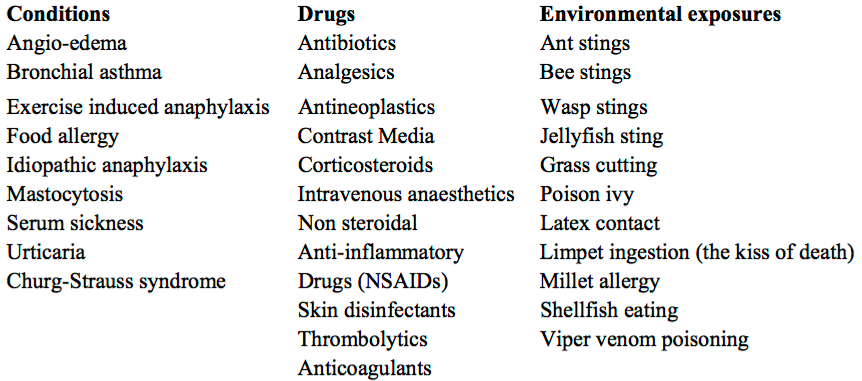
Causes of Kounis Syndrome


Treatment
   Steroids
   Anti-histaminics (H1 and H2 blockers)
   Vasodilators (NTG) and routine ACS treatment

   Adrenaline is the drug of choice and can save lives in anaphylaxis, but in Kounis syndrome there is a chance of aggravating ischemia and worsen coronary vasospasm. Despite this risk, in severe reactions, adrenaline should be given as wide spread manifestations of Anaphylaxis are life-threatening. Sulfite free adrenaline is recommended when available. Glucagon may be considered for those who take beta blockers and do not respond to adrenaline. Fentanyl shows a slight mast cell activation as compared to morphine and should be the drug of choice when opioid analgesia is necessary.


Posted by:


     Lakshay Chanana
     
     Speciality Doctor
     Northwick Park Hospital
     Department of Emergency Medicine
     England

     @EMDidactic


References:

  1. Kounis NG, Zavras GM. Histamine-induced coronary artery spasm: the concept of allergic angina. Br. J. Clin. Pract.45,121–128 (1991).
  2. Kounis NG, Zavras GM. Allergic angina and allergic myocardial infarction. Circulation94,1789 (1996).
  3. Kounis NG, Grapsas GM, Goudevenos JA. Unstable angina, allergic angina and allergic myocardial infarction. Circulation100,e156 (1999).

Monday, February 6, 2017

Angioedema - Bradykinin v/s Histamine

Angioedema
Angioedema is a Non-Pitting edema of reticular, dermal, subcutaneous and submucosal layers commonly affecting tongue, lips and upper airway (occasionally genitilia, abdomen, extremities)

Etiology

Allergic
  • Mast Cell/IgE mediated - Type I hypersensitivity reaction
  • Urticaria in common and a trigger is often present, acute onset
  • Responds to Anaphylaxis medications
Non-Allergic 
  • HAE (Hereditary Angioedema)
  • AAE (Acquired Angioedema)
  • Pseudo allergic 
  • Idiopathic 
  • ACEi related Angioedema 

Pathophys based classification
1. Histamine Mediated (Released from Mast cells or basophils)
Allergic or immunologic cause
2. Bradykinin Mediated
Hereditary or Acquired or ACE inhibitor induced edema
3. Idiopathic Angioedema 


Urticaria or Itching means histamine mediated reaction
Bradykinin affects more of deeper structures - not a/w itching but associated with pain and swelling

Presentation
Dysphagia, Change in voice, Abdominal pain, lump in throat, stridor, dyspnea 


Types:

1. Hereditary Angioedema  (HAE) - Accumulation of Bradykinin

  • Autosomal Dominant (ask for family history). Can have airway or extremity swellings
  • May present with recurrent abdominal pains due to mucosal swelling, urticaria is rare


  1. Type I: due to C1 inhibitor (C1-INH) deficiency - increased bradykinin - 85%
  2. Type II: Defective C1 inhibitor - need to test functionality 15-20%
  3. Type III: due to defective factor XII (Normal levels and fiction of C1-I) - Rare

HAE often present with Erythema Marginatum - serpeginous erythematous rash but not pathognomic


  • Triggers for HAE: Trauma, Medical Procedures, Stress, OCPs, Infection
  • Clinical diagnosis but also show reduced C4 levels
  • HAE does not respond to Anaphylaxis medications

2. Acquired Angioedema (Accumulation of Bradykinin)
Antibodies against C1 inhibitor  
AutoAb lead to reduction in C1-INH
Type 1- lymphoproliferative disorders (a/w lymphomas)
Type 2 - Autoimmune

Labs - Decreased levels of C1q (HAE - Normal C1q levels)

3. Pseudo allergic - not IgE mediated but mimics allergic AE
NSAIDs/Opioids/IV Contrast

4. Idiopathic - Unclear cause but common type of AE
All labs are normal
Chronic Urticaria can be a feature  

5. ACE inhibitor induced Angioedema - Accumulation of Bradykinin
  • More prevalent in African Americans, Females, Elderly 
  • ACEi interfere with bradykinin metabolism, therefore bradykinin mediated 
  • Can present as "isolated genital swelling" or "peritonitic abdomen"
  • Can develop with first dose or after years
  • Other meds that can cause - Sitagliptin, CCBs, ARBs, Alteplase (tPA), COX inhibitors
  • Patients who are on ACE inhibitor and get tPA are more likely to get tPA
  • Can be unilateral as well!! (Look at the image above)
  • ACEi Angioedema does not respond to Anaphylaxis medications
Recently I heard about a case where physicians did not give FFPs but intubated a patient with unilateral oral edema and also got a neck CT done. This patient was on ACEi for 6 years. FFP is a reasonable treatment option and must be considered prior to intubation. 

Consider sending a C4 level for undifferentiated angioedema (even if they are on ACEi, ACEi can unmask underlying Angioedema)


Differentials:
  • Lip Abscess
  • Panniculitis 
  • Ludwig's Angina 

Treatment

Supportive Care
  • Only a few of them require intubation
  • Majority resolve with observation and treatment. AIRWAY is our concern. 
  • Be concerned for potential airway compromise - Stridor, drooling, respiratory distress, change in voice 
  • Be prepared for a difficult airway (Fiberoptic, Surgical)

Allergic Angioedema (Think and treat like Anaphylaxis)
  • Epinephrine 0.3-0.5mg IM 1:1000
  • Epinephrine drip/Steroids/Antihistaminics
  • Fluids
HAE
Anaphylaxis cocktail does not help but often tried 
1) Traditional Rx - FFP (acute and chronic Rx), Antifibrinolytics (chronic), Androgens such as Danazol (chronic Rx)


Rationale for FFP: FFP contain C1-INH, other complement factors and kinin (dose 1-4 units for HAE). Few case reports mention worsening of angioedema. 

2) Newer Therapies
  • C1 INH concentrates (Berinert, Cinrynze) - For acute treatment 
  • Ecallantide (Plasma kallikrein inhibitors) - 30mg SQ, very expensive 
  • Icatibant (Bradykinin B2 receptor antagonists) - 30mg SQ


ACEi Angioedema
  • Anaphylaxis cocktail does not help but often tried 
  • Discontinue ACEi
  • Inconsistent data on ACEi induced Angioedema treatment 

Rationale for FFPsin ACEi Angioedema:

  • FFP's supply Kininase II which functions similar to ACE and degrades bradykinin
  • Inexpensive, easily available, improves symptoms
  • Risks - Volume overload, ?Possible worsening of Angioedema

Admit if
  • Past h/o angioedema
  • Tongue/pharynx/laryngeal edema
  • Lack of improvement in ED

Take Home
  • Strongly consider FFPs prior to intubation in any patient with Bradykinin induced Angioedema
  • Don't be surprised if Anaphylactic cocktail does not work for Bradykinin related reactions
  • Get ENT/Anesthesia involved early. This is not the time to learn intubation!

References
  • TemiƱo, Viviana M., and R. Stokes Peebles. "The spectrum and treatment of angioedema." The American journal of medicine 121.4 (2008): 282-286.
  • Lewis, Lawrence M. "Angioedema: etiology, pathophysiology, current and emerging therapies." The Journal of emergency medicine 45.5 (2013): 789-796.
  • Winters, Michael E., et al. "Emergency department management of patients with ACE-inhibitor angioedema." The Journal of emergency medicine 45.5 (2013): 775-780.

Author:

              
     Lakshay Chanana
     
     Speciality Doctor
     Northwick Park Hospital
     Department of Emergency Medicine
     England

     @EMDidactic


Thursday, January 29, 2015

Anaphylaxis - Now on the podcast !


Hi there!

Last week we dealt with anaphylaxis, now it is available on the podcast (15minutes).
This was a session which I took sometime back for the residents (The Flipped Classroom).


I still see shocked patients getting a trial of steroids/antihistaminics before epinephrine. Steroids/Antihistaminics work (if at all!) to prevent the biphasic reaction and relieve the skin symptoms.

Epinephrine is the DRUG of choice for anaphylaxis and it should be administered ASAP.


This podcast will give you an understanding about when and how to use epinephrine.

Listen to the podcast.
There is also a handout available.


Thursday, January 22, 2015

Anaphylaxis - how are we doing?

Anaphylaxis is often one of the first emergencies which is taught to the residents. But how good are we in treating anaphylaxis - as emergency health care providers? Well, the literature says that the DOC for anaphylaxis (Epinephrine) is under-utilised, under prescribed for future use! 

Let us familiarise ourselves once again with the management of anaphylaxis, no groundbreaking information here, just a review of what we are supposed to do. 

Diagnostic criteria: Likely if any one of these criteria are met:
  1. Acute onset illness with involvement of skin and/or mucosa accompanied by either respiratory compromise, falling blood pressure or end organ dysfunction. 
  2. Two or more of the following symptoms occurring rapidly after exposure to the likely allergen: involvement of skin and/or mucosa, signs of respiratory compromise, falling blood pressure or end organ dysfunction and persistent GI symptoms. 
  3. Falling blood pressure within minutes to several hours following exposure to a known allergen.
(Note: Do not equate anaphylaxis with hypotension/shock. Hypotension is not mandatory to administer epinephrine)

Signs and symptoms: It is primarily a clinical diagnosis. Labs are rarely helpful. 
Skin is almost always involved in about 80% of the cases. Other major systems which can be involved are: 

Skin: flushing, urticaria, angioedema, warmth, swelling, conjunctival injection
RS: Nasal congestion, Coryza, rhinorhea, sneezing, throat tightness, wheezing, SOB, cough, hoarseness of voice
CVS: dizziness, weakness, syncope, chest pain, palpitations
GI: Dysphagia, nausea and vomiting, diarrhoea, bloating, cramps
CNS: headache, dizziness, blurred vision, seizure (rare)

Management 
ABCs (Anticipate challenging airway, keep plan B ready)
O2, fluids and epinephrine
IM Epi 0.5mg 1:1000 anterolateral thigh, repeat q5-10min x 3

Adjuncts
Steroids, H1/H2 blockers, bronchodilators
For those on beta blockers : glucagon
Other vasopressors : epi, vasopressin, nor epi infusion 

Decide on admission discharge based on doses of epi required, age, comorbidities. 


Bottomline:
Know the diagnostic criteria for anaphylaxis
Don't delay epinephrine 
Hypotension is not mandatory to diagnose anaphylaxis 
Fluids, O2 and Epinephrine - treatment for anaphylaxis (not steroids and antihistaminics)
Give epi pen and educate them at discharge 

Check out the recent guidelines for more info: